+1 561 855 1409
 Polartec: The Synthetic Fleece That Revolutionized Outdoor Apparel
Polartec is an American textile brand that has become synonymous with high-performance synthetic fleece. While the company now produces over 400 different fabric types, fleece remains its flagship product, used by major sportswear manufacturers in a wide variety of outerwear.

A Brief History: From Near Bankruptcy to Industry Leader
The Polartec story begins in 1906 with Malden Mills, a Massachusetts textile manufacturer that struggled financially for decades. Everything changed in 1981 when the company developed synthetic fleece.
In partnership with Patagonia, then a small mountaineering company, Malden Mills launched the fabric under the name Synchilla (synthetic + chinchilla) that quickly became a sensation. It was cheaper than wool, dramatically lighter, and exceptionally warm, making it ideal for active outdoor use.
By the early 1990s, the material gained the commercial name Polarfleece and later the broader label Polartec. Despite factory fires, bankruptcies, and economic challenges, the company’s commitment to textile innovation eventually led to its reorganization as Polartec, LLC in 2007. Since then, Polartec has steadily expanded its global presence and diversified its technologies to compete with brands such as W.L. Gore (GORE-TEX), Columbia Sportswear, and other performance textile manufacturers.
Today, Polartec supplies every branch of the US military and major brands like The North Face, L.L. Bean, and Marmot.
What Sets Polartec Apart
Polartec stands out for its scientific approach to fabric engineering. While many companies produce fleece and synthetic insulation, Polartec focuses on creating materials that solve very specific performance challenges. Its fabrics are designed to control moisture, retain warmth with minimal weight, resist wind or water, or provide breathable weather protection.
Compared to traditional wool, Polartec fleece is significantly lighter: a 100gsm Polartec garment provides the same insulation as a 500gsm wool fleece garment while weighing only one-fifth as much.
Polartec is also extremely hydrophobic and absorbs less than one percent of its weight in water, making it far more suitable for sports and high-mobility activities.
Polartec’s innovations have also expanded beyond fleece into waterproof membranes, next-generation insulations, flame-resistant fabrics, and highly breathable base layers—areas where many competing brands focus on only one or two categories.
Types of Polartec Fleece
Base Layer Fabrics address breathability concerns with products like Power Dry, Power Grid, and Delta, which is ideal for warm-weather activities.
Insulative Fabrics include variations on the original fleece such as Alpha, Thermal Pro, High Loft, Wind Pro, and others.
Weather Protection Fabrics like NeoShell (launched in 2011) compete directly with GORE-TEX, while Power Shield and WindBloc offer waterproofing and windproofing properties.
Flame-Resistant Fabrics were developed for the US military in 2003 to prevent melting from IED heat, and now include consumer products like Power Dry FR and Thermal Pro FR.
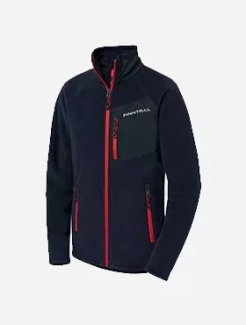
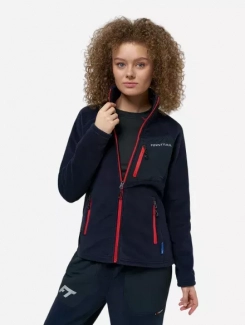
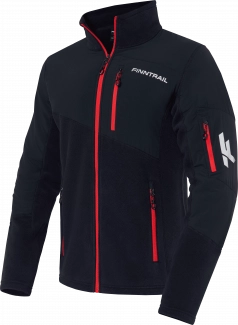
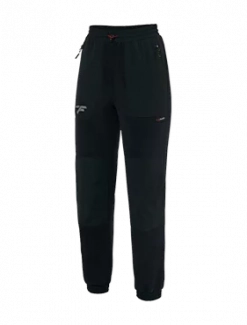
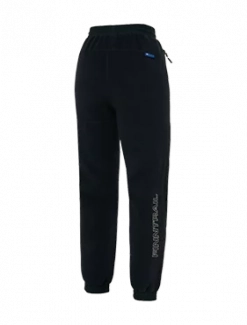
In FINNTRAIL we use Polartec Thermal Pro, one of the most versatile insulative fabrics in the Polartec lineup. We incorporate Polartec Thermal Pro into garments that function either as primary layers for cool weather or as insulating mid-layers under membrane outerwear. For active outdoor enthusiasts—whether riding, hiking, or fishing—this combination provides reliable warmth, freedom of movement, and efficient moisture control.
Environmental Impact and Certifications
Despite relying on polyester—a petroleum-based material—Polartec has made significant progress in improving the sustainability of its fabrics. The company was one of the first to introduce fleece made entirely from recycled plastic bottles, a practice that continues to reduce plastic waste and energy consumption.
However, all synthetic fleece contributes to microfiber pollution. Polartec addresses this challenge through new fabric constructions like Polartec Power Air, which sheds significantly fewer fibers during washing. Additionally, since 2005 all Polartec fabrics have been OEKO-TEX certified, confirming that they are produced without harmful substances and meet strict environmental and safety standards.
Conclusion
Polartec has shaped modern outdoor apparel like few other textile brands. From its beginnings as a groundbreaking replacement for wool fleece to its position today as a leader in performance fabric innovation, Polartec continues to set standards for warmth, comfort, durability, and technical versatility. Its fleece materials provide dependable insulation and functionality for active outdoor lifestyles, whether worn as standalone layers or combined with protective membrane outerwear.
With a strong focus on innovation and sustainability, Polartec remains one of the most trusted and forward-thinking names in performance textiles.